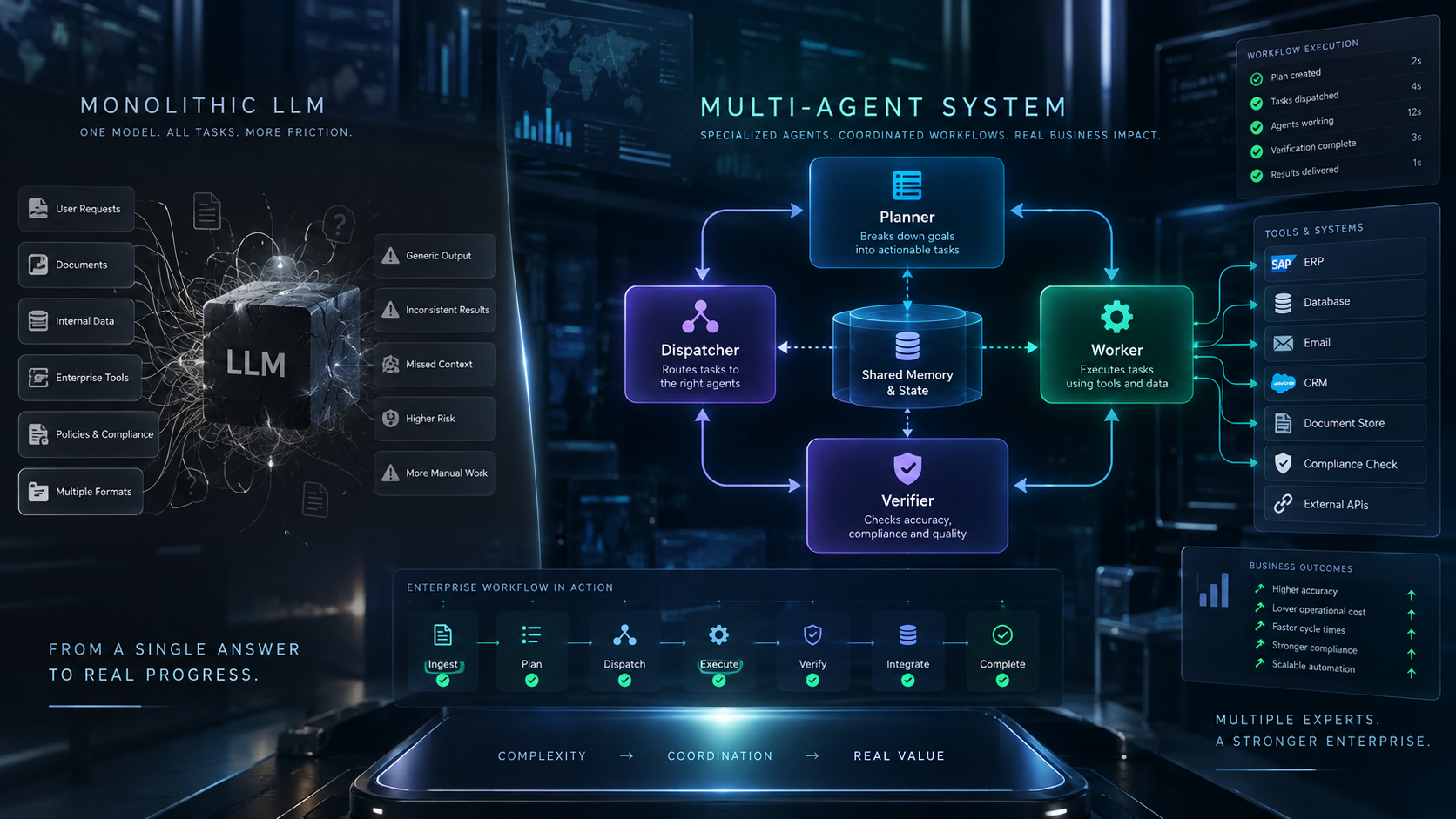
The Fragility of the 'One Big Prompt' Approach
Over the past two years, many enterprises rushed to build generative AI solutions by stacking thousands of tokens into a single prompt. While this works for conversational drafting or semantic search, it fundamentally fails when applied to enterprise operations such as reconciliation, dynamic invoice processing, or compliance verification. As token counts rise and instructions multiply, single LLM instances suffer from context dilution, instruction evasion, and unpredictable hallucinations.
"Enterprise operations cannot tolerate probabilistic guesswork. When a workflow moves money, updates databases, or interfaces with customers, precision must be deterministic."
Deconstructing Complex Tasks: The Multi-Agent Paradigm
Instead of asking one general model to read an invoice, cross-examine payment records, calculate taxes, and dispatch an ERP entry, modern multi-agent systems assign discrete roles to specialized agent personas. A Planner Agent outlines the step-by-step DAG (Directed Acyclic Graph); Worker Agents execute isolated API calls; and a Critic or Verifier Agent tests the final payload against strict JSON schemas before committing state.
State Management and Human-in-the-Loop Safeguards
The true advantage of multi-agent topologies lies in resilient state persistence. By tracking state machines with durable event logs, if a third-party API times out or requires multi-factor authentication, the agent pauses its branch and notifies human operators with exact context, resuming automatically upon verification without starting over.
Quantified Impact in Production
At LINXAAI, clients transitioning from single-prompt pipelines to stateful multi-agent architectures routinely observe a 3.4x improvement in end-to-end task completion rate and a 60% reduction in overall inference token expenses due to focused context windows.